
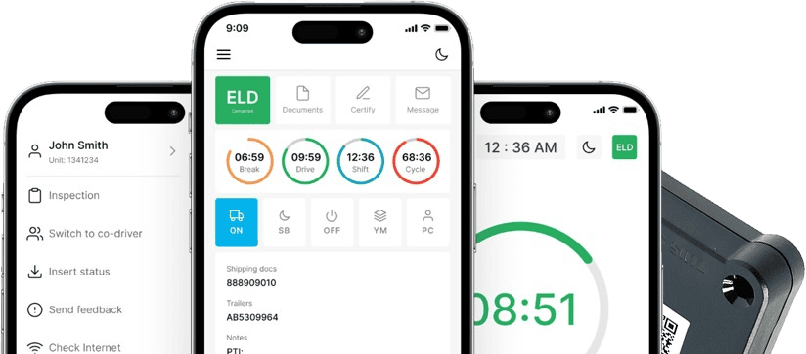

FMCSA ELD Compliance Guide for Truck Drivers and Fleet Owners
Passing a roadside inspection or a DOT audit comes down to more than owning the right hardware. FMCSA ELD compliance covers how a device is used every day, whether logs are certified correctly, and whether a carrier can produce supporting records when asked. This guide walks through the mandate itself, current Hours of Service requirements, the violations that trip up drivers most often, and what a fleet should have in place before an inspector or auditor shows up.
This article provides general information for educational purposes. It is not legal advice, and specific compliance questions should be directed to FMCSA or a qualified compliance professional.
What Is FMCSA ELD Compliance?
FMCSA ELD compliance means using a self-certified, FMCSA-registered electronic logging device correctly, not simply having one installed in the truck. A device that is plugged in but poorly understood by the driver, or a fleet that never reviews the records it generates, is not actually compliant even though the hardware is present.
Real compliance includes several layers working together:
- Using a device that appears on FMCSA’s list of registered ELDs
- Selecting accurate duty status throughout the day
- Certifying records of duty status (RODS) at the end of each 24-hour period
- Annotating any edits with a clear explanation
- Retaining required supporting documents alongside the electronic record
- Following the correct procedure if the device malfunctions
Installing hardware is the starting point. DOT compliance depends on what happens after the device is running.
Understanding the ELD Mandate and Its Purpose
The ELD rule was published by FMCSA in December 2015 under authority granted by the 2012 MAP-21 highway funding law, with full mandatory use taking effect December 16, 2019. The rule requires most drivers who must keep records of duty status to log their Hours of Service (HOS) electronically instead of on paper.
The purpose is directly tied to Hours of Service enforcement. Before the mandate, paper logs were easy to alter after the fact, which made it difficult for safety officials to confirm whether a driver had actually taken required rest. An ELD pulls driving time straight from the vehicle’s engine, which creates a record that is harder to falsify and easier for both the driver and an inspector to verify.
The ELD mandate did not change the underlying HOS limits. It changed how those limits are recorded and verified.
Who Needs to Use an FMCSA-Certified ELD?
You’ll see the phrase “FMCSA-certified ELD” used often in search results, and it’s worth clarifying what that actually means before going further. FMCSA does not test or independently certify individual devices before they reach the market. ELD manufacturers self-certify that their device meets the technical specifications in 49 CFR Part 395, Subpart B, then register it on FMCSA’s public list. A more accurate way to describe a compliant unit is a self-certified and FMCSA-registered ELD.
Who is generally subject to the requirement. Interstate drivers of property-carrying and passenger-carrying commercial motor vehicles who are required to prepare RODS for more than 8 days within any 30-day period fall under the mandate.
Drivers who may qualify for an exemption:
- Short-haul drivers operating under the 395.1(e) exception, who stay within a 150 air-mile radius of their normal work reporting location, return there the same day, and stay within the applicable duty-period limit
- Drivers who use paper RODS no more than 8 days in any rolling 30-day period
- Driveaway-towaway operations, where the vehicle being driven is itself the commodity being delivered
- Drivers operating vehicles with an engine model year older than 2000
Why fleets should evaluate each operation individually. Exemption eligibility depends on the specific route, duty period, and vehicle involved, not on the type of business a carrier runs. A fleet with mixed operations, some local and some long-haul, may have drivers who qualify for an exemption on certain days and not on others. Assuming an entire fleet is exempt because most routes are short can create gaps that only surface during an inspection.
Hours of Service Rules and ELD Requirements
An ELD does not set Hours of Service limits. It records compliance with limits that already exist under 49 CFR Part 395. For property-carrying commercial vehicles, the core structure looks like this:
- Driving time. A driver may drive a maximum of 11 hours after 10 consecutive hours off duty.
- On-duty window. All driving must be completed within 14 consecutive hours of coming on duty. This window does not pause for fuel stops, loading delays, or meal breaks, only a qualifying off-duty reset restarts it.
- Off-duty status. A minimum of 10 consecutive hours off duty is required before the driving and duty windows reset.
- Sleeper-berth status. Drivers may split the required off-duty time using an 8/2 or 7/3 sleeper-berth combination, with the longer period spent in the berth.
- Required breaks. A 30-minute break is required after 8 cumulative hours of driving time. This break can be satisfied with off-duty time, sleeper-berth time, or on-duty, not-driving time.
- Weekly limits. Drivers cannot drive after accumulating 60 hours on duty in 7 consecutive days, or 70 hours in 8 consecutive days, depending on the carrier’s operating schedule. A 34-hour off-duty period can reset this weekly cycle.
- Log certification. At the end of each 24-hour period, the driver must certify that the record accurately reflects the day.
- Personal conveyance and yard moves. These are recognized categories under FMCSA guidance and carrier policy that allow certain movements to be logged outside standard driving time, but the specific conditions are defined by the carrier’s policy and should be confirmed with current FMCSA guidance rather than assumed.
Carrier and driver responsibilities. The carrier is responsible for using a registered device, training drivers on it, and retaining supporting documents. The driver is responsible for selecting the correct duty status in real time and certifying the record at the end of the shift. Neither responsibility transfers to the device itself.
Common ELD Violations That Affect Truck Drivers
Using an unregistered or non-compliant device. Some units in circulation are not on FMCSA’s current list of registered ELDs. Confirm the specific model and firmware version before relying on it.
Failing to log in. Driving without logging into the device creates unassigned driving time that has to be resolved later, and it can look like an attempt to avoid recording hours.
Incorrect duty status. Marking on-duty time as off-duty, commonly during loading or a fuel stop, misrepresents the actual workday and is one of the most frequent findings during inspections.
Unassigned driving time. When the vehicle moves without a driver logged in, the system records the segment as unidentified. Someone has to claim and annotate it, or it remains an unresolved gap in the record.
Missing log certification. A record that is never certified at the end of the 24-hour period is considered incomplete, even if every entry in it is accurate.
Unsupported edits. Every edit needs an annotation explaining the reason for the change. An edit with no explanation raises questions about whether the original entry was accurate.
Missing annotations. Beyond edits, certain manual entries, such as personal conveyance or a malfunction period, require a written note explaining the circumstances.
Failing to follow malfunction procedures. When an ELD malfunctions, the driver must reconstruct records for the current 24-hour period and the previous 7 days if that data isn’t already retained, and notify the motor carrier within 24 hours. The carrier then has 8 days to repair, replace, or service the device.
Inability to display or transfer records. A device that can’t show inspection-mode data or complete an electronic transfer during a roadside inspection defeats the purpose of having one.
Missing required supporting documents. Items like bills of lading, dispatch records, and fuel receipts back up the electronic record and are often requested alongside HOS data during an audit.
How Accurate Electronic Logs Improve Compliance
Automatic capture of driving time removes a major source of manual error, since the device records movement directly from the engine rather than relying on a driver’s memory at the end of a shift. That reduces the number of small transcription mistakes that used to show up on paper logs.
It does not remove the need for driver judgment. Duty-status changes, such as switching from driving to on-duty-not-driving, still require the driver to make a selection, and the system has no way of knowing why a truck is stopped unless the driver tells it. Reviewing the log before certifying it, correcting entries with a proper annotation, and following up on unidentified driving segments are steps that depend entirely on the people using the system.
For carriers, this means oversight still matters. A fleet manager who reviews logs regularly can catch a recurring pattern, like a driver consistently misclassifying on-duty time, well before it becomes a pattern an auditor notices first.
Preparing Your Fleet for DOT Compliance Checks
A practical readiness checklist for drivers and safety teams includes:
- Driver training on the specific ELD model in use, not just general HOS concepts
- Correct login credentials for every driver, so no one is driving unassigned
- Current logs that are certified and free of unresolved edits
- Supporting documents carried and organized for the current trip
- Inspection mode that the driver knows how to access without hesitation
- Data-transfer procedures tested so the driver is comfortable with both telematic and local transfer methods
- Device instruction materials kept in the cab, since drivers are required to have them available
- Malfunction instructions so drivers know the notification and documentation steps if the device fails
- Blank paper logs on hand as backup during a malfunction or transition period
- Vehicle and diagnostic-port connections checked periodically to confirm the device is reading data correctly
- Internal log reviews on a regular schedule, not only after a violation appears
Common Mistakes Companies Make With ELD Systems
Treating installation as the end of compliance. Hardware alone does not manage HOS. Ongoing review is what actually catches problems.
Inadequate driver training. A driver who doesn’t understand the interface is more likely to select the wrong duty status or miss a certification step.
Ignoring unidentified driving events. These accumulate quickly across a fleet and can point to bigger training gaps if left unaddressed.
Improperly suggesting log edits. A dispatcher or manager directing a driver to change a duty status without a legitimate reason creates a record that misrepresents what actually happened, which is a serious compliance risk.
Failing to monitor recurring violations. A single mistake is a training opportunity. The same mistake repeated across multiple drivers points to a systemic issue.
Choosing incompatible hardware. A device that doesn’t match a fleet’s engine types or diagnostic-port protocols creates connectivity problems that show up as data gaps.
Poor malfunction procedures. Not knowing the required notification and documentation steps turns a routine hardware issue into a compliance gap.
Weak document retention. Supporting documents that are misplaced or inconsistently filed make audits slower and harder to resolve.
Using outdated compliance policies. HOS guidance and exemption details are updated periodically. A policy written years ago may no longer reflect current requirements.
How ELD Solutions Simplify Compliance Management
A well-organized ELD system gives fleet managers a single place to review logs instead of collecting paper from every truck individually. Compliance reports can flag missing certifications or unresolved edits before they turn into a pattern. Driver-facing dashboards make it easier for a driver to review their own day and catch a mistake before certifying it.
None of this replaces oversight. A system organizes information and surfaces issues, but a person still has to review that information and act on it. Trucking compliance improves when the technology and the people using it are both doing their part.
Benefits of Using an FMCSA-Registered ELD
- Accurate driving-time capture pulled directly from the vehicle’s engine rather than manual estimation
- Clearer log review through a standardized digital format instead of handwritten entries
- Faster record retrieval when a driver or manager needs to pull up a specific day
- Inspection readiness through built-in inspection mode and electronic data transfer
- Reduced administrative work compared to manually collecting and filing paper logs
- Fleet-level reporting that gives managers visibility across every truck from one dashboard
- Identification of recurring logging issues before they become a repeated finding during an audit
- Support for driver coaching by giving managers concrete examples to review with individual drivers
Using a registered device does not mean FMCSA has endorsed a specific product, and it does not guarantee an inspection-free record. It provides the tools to record and manage HOS accurately, but the outcome still depends on how those tools are used.
How LogSafe US Supports Fleet Compliance
The problems covered throughout this guide, from diagnostic-port compatibility to malfunction handling and supporting document organization, are areas where the right hardware and service actually make a difference day to day.
LogSafe US supplies the PT30 ELD hardware, which installs through a single connection to the vehicle’s diagnostic port using J1939, J1708/J1587, or OBD-II interfaces depending on the truck, and connects to the driver application over Bluetooth Low Energy. For fleets running different connector types, LogSafe US also carries a 9-pin cable, a 16-pin cable for Volvo and Mack trucks, and a 16-pin OBD-II cable for light and medium duty vehicles.
Beyond the hardware, the service includes electronic Hours of Service recording, a mobile application with compliance reports, log review and correction tools, DOT audit assistance, compliance consulting, and safety management and reporting. Support runs 24/7 in English, Russian, Uzbek, Arabic, and Spanish, and the service is month-to-month with no long-term contract for owner-operators and fleets across the United States.
If your fleet is evaluating a device change or wants a second look at your current compliance setup, you can view the PT30 ELD solution or contact LogSafe US to talk through your specific requirements.
Frequently Asked Questions
What is FMCSA ELD compliance?
It means using a self-certified, FMCSA-registered ELD correctly, including accurate duty status, certified logs, proper annotations, and required supporting documents.
Who needs to use an FMCSA-certified ELD?
Most drivers required to keep records of duty status beyond 8 days in 30 days, though short-haul, driveaway-towaway, and pre-2000 vehicle exemptions may apply.
What happens if a driver does not use an ELD?
Enforcement outcomes vary by violation and circumstances, but missing or non-compliant ELD use can result in citations, out-of-service orders, or further review.
How does an ELD help during DOT inspections?
It displays current and prior HOS records in inspection mode and allows electronic transfer to the officer, speeding up the review process.
Are small trucking companies required to use ELDs?
Fleet size alone doesn’t determine the requirement. It depends on whether individual drivers must keep RODS and whether an exemption applies.


