

How Trucking Companies Can Avoid Common DOT Violations and Penalties
Real DOT audit preparation happens months before an auditor ever contacts your company, not in the days after you get the notice. It comes from how consistently you manage driver qualification files, Hours of Service records, vehicle maintenance documentation, and drug and alcohol testing compliance throughout the year. This guide walks through what a DOT audit actually involves, the records most often requested, the mistakes that lead to poor outcomes, and how to build a recordkeeping rhythm that holds up whether the review happens next month or next year.
This article provides general information for educational purposes. It is not legal advice, and specific compliance questions should be directed to FMCSA or a qualified compliance professional.
What Is a DOT Audit and Why Does It Matter?
“DOT audit” is a term used loosely across the industry, and it can refer to several different FMCSA reviews that are not the same procedure. Understanding which one applies to your situation matters, because the scope, documentation requested, and possible outcomes differ.
The Federal Motor Carrier Safety Administration generally conducts these reviews:
- New Entrant Safety Audit. Every new interstate motor carrier is placed in an 18-month monitoring period after receiving a USDOT number, and a Safety Audit typically occurs within that window, often in the first several months. It is a pass-or-fail review focused on confirming basic safety management controls are in place, not a road test of the vehicles themselves.
- Compliance Review. This is a more comprehensive, on-site or off-site investigation of an existing carrier’s operations, used when safety data suggests a problem or as part of ongoing oversight. It can result in a safety rating of Satisfactory, Conditional, or Unsatisfactory.
- Focused or comprehensive investigation. These are targeted reviews, often triggered by specific safety concerns, elevated CSA scores, or a serious incident, and can range in scope depending on what prompted them.
- Roadside DOT inspection. This happens at the vehicle level, typically during a stop, and is a different process entirely from a carrier-level audit. An inspector reviews the driver, the vehicle, and the current logs and supporting documents in that moment.
- Internal carrier audit. This is a voluntary, self-directed review a company runs on its own files to catch problems before an external review does.
A carrier facing an official notice should identify exactly which type of review is underway before assuming what will be requested. Outcomes vary by review type and depend on the specific findings, and it is not accurate to describe every deficiency as leading to the same consequence. Depending on severity and history, results can range from a corrective action requirement to a downgraded safety rating or, in serious cases, an out-of-service order.
Common Reasons Trucking Companies Fail DOT Audits
Incomplete driver qualification files. Missing employment applications, road test certificates, or annual reviews are among the most frequently cited issues in reviews.
Hours of Service violations. Exceeding the driving window, missing required breaks, or failing to certify logs shows up often when records of duty status are reviewed closely.
Missing or inaccurate ELD records. Gaps in electronic logs, unresolved unidentified driving time, or unsupported edits raise questions about the reliability of the entire record.
Poor vehicle maintenance documentation. Missing inspection reports or an incomplete maintenance history for a vehicle can point to a larger gap in preventive maintenance practices.
Drug and alcohol testing deficiencies. Missing pre-employment tests, incomplete random testing program documentation, or gaps in required records under 49 CFR Part 382 are a common area of concern.
Clearinghouse failures. Carriers are required to conduct specific Clearinghouse queries for drivers, and missing or incomplete query records are a recurring finding.
Missing accident records. An incomplete accident register under 49 CFR Part 390 leaves a gap in the safety history an auditor needs to review.
Improper CDL or medical qualification records. An expired medical certificate or missing CDL verification undermines a driver’s qualification status.
Inadequate record retention. Discarding records before their required retention period, or being unable to produce them within the requested timeframe, is treated as a significant gap regardless of intent.
Failure to correct repeated safety issues. A pattern of the same violation across multiple drivers or trips suggests a systemic problem rather than an isolated mistake.
Lack of documented safety procedures. Reviewers look for evidence that a carrier has actual written policies and processes, not just verbal understanding of requirements.
Not every one of these issues produces an identical result. A single missing document is handled differently than a widespread, repeated pattern across the fleet.
Important Documents Required During a DOT Audit
Exact requirements depend on the type of review, your specific operation, vehicle types, driver classifications, and whether you operate in interstate or intrastate commerce. The table below reflects general categories and commonly cited retention periods under federal regulations, but retention requirements are not identical across all record types, and some operations have additional or different obligations.
| Record Category | Examples | Responsible Team | Retention Note |
| Company registration and operating authority | USDOT number, MC number, MCS-150 updates | Owner/compliance officer | Kept current per 49 CFR 390.19 update schedule |
| Insurance and financial responsibility | Proof of liability coverage, filings | Owner/office administration | Maintained while authority is active |
| Driver qualification files | Application, road test, annual review | Safety/HR | Duration of employment plus 3 years under 49 CFR 391.51 |
| CDL and medical qualification | CDL verification, medical examiner’s certificate | Safety/HR | Generally 3 years from date of execution |
| Motor vehicle records | Annual MVR reviews, violation checks | Safety/HR | Generally 3 years from date of execution |
| Drug and alcohol testing records | Test results, collection records, program documentation | Compliance officer/DER | Varies by record type under 49 CFR 382.401, from 1 year to 5 years |
| Clearinghouse records | Query results, consent documentation | Compliance officer | Maintained per current Clearinghouse program requirements |
| Hours of Service records | RODS, timecards, ELD data | Driver/dispatch | 6 months under 49 CFR 395.8 |
| ELD data and supporting documents | Bills of lading, dispatch records, fuel receipts | Driver/dispatch | 6 months, aligned with HOS record retention |
| Vehicle inspection, repair and maintenance | Work orders, DVIRs, repair history | Maintenance team | Generally 1 year plus 6 months after the vehicle leaves the fleet under 49 CFR 396.3 |
| Annual inspections | Periodic inspection reports | Maintenance team | Generally 14 months |
| Accident register | Date, location, injuries, HazMat involvement | Safety manager | Generally 3 years from the date of the accident under 49 CFR 390.15 |
| Hazardous materials records | Shipping papers, training records where applicable | Safety/HazMat coordinator | Varies by requirement; confirm current rules if applicable |
| Policies and training documentation | Written safety policies, onboarding records | Safety manager | Maintained while relevant, per company policy and applicable regulation |
Reviewing Driver Logs Before an Inspection
A structured review of driver logs before a roadside inspection or an audit request should look for:
- Missing driver certifications, where a record was never certified at the end of the 24-hour period
- Unidentified driving events, which need to be claimed and annotated by the responsible driver
- Unassigned driving time, similar to unidentified events but often tied to shared or incorrect login credentials
- Incorrect duty statuses, especially on-duty time recorded as off-duty during loading or fueling
- Missing annotations on edits or special statuses like personal conveyance
- Personal-conveyance use that falls outside the criteria defined by FMCSA guidance and carrier policy
- Yard-move use applied outside its intended purpose
- Form-and-manner errors, such as missing shipping document numbers
- Hours of Service violations, including exceeded driving limits or missed breaks
- ELD malfunctions that were not documented or reported within the required timeframe
- Supporting-document inconsistencies, where a bill of lading or dispatch record doesn’t match the electronic log
Carriers may suggest legitimate edits when a genuine error is identified, but the driver must review and either accept or reject the change with an annotation explaining it. Automatically recorded driving time should never be removed or altered without that documented, driver-reviewed process.
How ELD Records Support DOT Audit Preparation
Organized electronic Hours of Service data makes it faster to pull a specific driver’s record for a specific date, which matters when an audit request has a tight response window. It also supports driver-log review, since duty-status patterns are easier to spot across a digital dashboard than across a stack of paper logs.
Electronic records help with inspection data transfer, identification of recurring problems across a fleet, and reconciling supporting documents against the log itself. That said, ELD data can also surface violations rather than hide them. A gap, an unresolved unidentified driving segment, or a pattern of duty-status errors shows up clearly in the record, which means the technology organizes information but does not filter out problems. Accurate driver input, ongoing carrier oversight, and complete supporting documentation still carry the weight of actual compliance.
Common Compliance Issues Found During Audits
Driver qualification. Incomplete files or missing annual reviews are addressed by building a standing checklist for every new hire and a recurring reminder system for annual requirements.
Hours of Service. Recurring driving-window or break violations are best addressed through driver training combined with dispatch scheduling that accounts for realistic transit and loading time.
Controlled substances and alcohol testing. Gaps in the random testing pool or missing pre-employment tests are prevented by assigning a specific person to manage the testing program calendar.
Vehicle maintenance. Missing repair documentation is prevented by requiring a paper or digital work order for every service event, tied to the specific vehicle.
Required inspections. Missed annual inspections are prevented with a tracked schedule tied to each vehicle’s inspection date, not a general fleet-wide reminder.
Accident reporting. Gaps in the accident register are prevented by logging every qualifying incident immediately, rather than relying on memory later.
Insurance documentation. Lapses are prevented by confirming renewal dates well ahead of expiration rather than at the deadline.
Operating authority. Outdated MCS-150 information is corrected by updating it on the required schedule under 49 CFR 390.19, not only when a change happens to be noticed.
Training. Undocumented driver training is addressed by keeping signed records of every session, not just informal notes.
Hazardous materials. Where applicable, gaps are addressed by confirming current shipping paper and training requirements directly through FMCSA HazMat guidance.
Safety Management Practices Fleets Should Follow
Sustainable fleet safety management depends on more than reactive paperwork. Practices that hold up over time include:
- Written policies covering HOS, drug and alcohol testing, and vehicle maintenance expectations
- Clearly defined staff responsibilities, so it’s known who owns each record category
- Structured driver onboarding that includes qualification file completion before the first dispatch
- Recurring training on HOS rules, ELD use, and company policy updates
- Internal record reviews on a regular schedule rather than only before an expected audit
- Preventive maintenance scheduling tied to mileage or time intervals
- Violation monitoring that tracks patterns across drivers, not just individual incidents
- Documented corrective-action steps whenever a violation or deficiency is identified
- Management oversight that includes periodic review of compliance reports, not just delegation
- Record-retention schedules that match current federal requirements for each record type
- Periodic mock audits that test whether records can actually be produced quickly
Paperwork alone does not demonstrate effective safety management. A binder full of policies that nobody follows day to day does not reflect the same safety posture as consistent, verifiable practices.
Preparing Drivers for DOT Inspections
Carrier-level audit preparation and roadside driver readiness are related but distinct. A carrier audit looks at the company’s records and systems as a whole. A roadside inspection happens in the moment, with a specific driver and vehicle.
A practical driver-level checklist includes:
- Valid CDL with required endorsements for the vehicle and cargo type
- Medical qualification documentation where required
- Current duty status that reflects what’s actually happening at the time of inspection
- Certified logs with no outstanding gaps
- Supporting documents carried and organized for the trip
- ELD instructions available in the cab for the specific device model
- Data-transfer procedures the driver can perform confidently on request
- Malfunction instructions covering notification steps if the device fails
- Blank paper logs, kept as backup where required
- Vehicle inspection documentation, including the most recent pre-trip and post-trip reports
- Professional and accurate communication with the inspecting officer
Using Technology to Improve Compliance Tracking
Technology can support several parts of ongoing compliance work: ELD monitoring for HOS visibility, maintenance reminders tied to specific vehicles, document organization for driver files, expiration alerts for medical certificates or annual reviews, compliance reporting for fleet-wide visibility, driver coaching based on recorded patterns, trend identification across recurring issues, and tracking whether corrective actions were actually completed.
None of this replaces qualified compliance review or management accountability. Software can flag that a medical certificate is expiring or that a driver has a recurring duty-status error. Deciding how to respond, following through on training, and maintaining the underlying records still requires people paying attention.
How to Maintain Audit-Ready Fleet Records
The frequencies below are operational recommendations for building good habits, not federal mandates. Actual regulatory deadlines, such as annual inspections or medical certificate renewals, follow the specific timelines set by the applicable regulation.
Daily or Ongoing Tasks
- Drivers certify logs at the end of each shift
- Dispatch confirms no driver is operating without being logged into the ELD
- Pre-trip and post-trip vehicle inspections are completed and documented
Weekly Reviews
- Safety manager reviews unidentified driving events across the fleet
- Dispatch checks for unresolved duty-status or annotation issues
- Maintenance team reviews any reported vehicle defects
Monthly Reviews
- Compliance officer reviews HOS violation trends by driver
- Safety manager audits a sample of driver qualification files for completeness
- Maintenance records are reconciled against the fleet’s service schedule
Quarterly Reviews
- Random drug and alcohol testing pool status is verified
- Clearinghouse query records are reviewed for completeness
- Company owner reviews overall compliance reports with the safety manager
Annual Reviews
- Driver qualification files receive the required annual review
- Motor vehicle records are pulled and reviewed for each driver
- Operating authority and insurance filings are confirmed current
- Vehicle annual inspections are scheduled and tracked to completion
When Drivers or Vehicles Are Added
- A complete driver qualification file is built before the first dispatch
- Required drug testing, including pre-employment testing, is completed
- Clearinghouse queries are run for the new driver
- New vehicles are added to the maintenance and inspection tracking system
How LogSafe US Helps Fleets Prepare for Audits
Several of the challenges covered in this guide, from organizing electronic HOS records to reviewing driver logs before they become a problem, are areas where the right tools support the process without doing the compliance work for you.
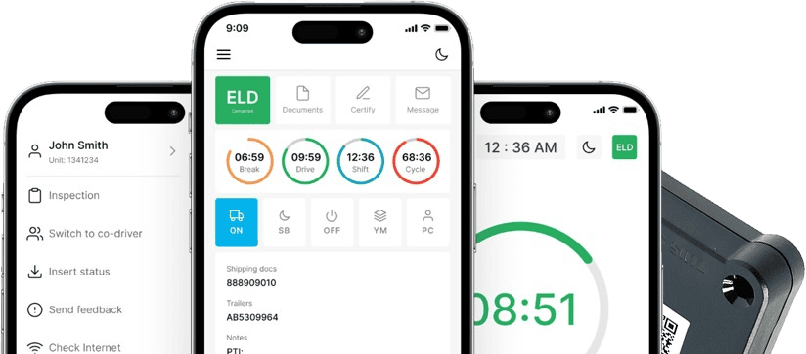
LogSafe US supplies the PT30 ELD hardware, which connects to the vehicle’s diagnostic port through J1939, J1708/J1587, or OBD-II interfaces and pairs with the driver application over Bluetooth Low Energy, giving fleets electronic Hours of Service records that are organized and easier to retrieve than paper logs. The service includes log review and correction tools, compliance reports, DOT audit assistance, compliance consulting, and safety management and reporting. Support is available 24/7 in English, Russian, Uzbek, Arabic, and Spanish, and the service runs month-to-month with no long-term contract for owner-operators and fleets across the United States.
Using these tools does not guarantee a successful audit outcome or freedom from violations. What they provide is better organization and visibility, which supports the ongoing recordkeeping work described throughout this guide.
If your fleet is working through its DOT audit checklist or reviewing your current ELD setup, you can view the PT30 ELD solution or contact LogSafe US to talk through your audit-readiness and compliance needs.
Frequently Asked Questions
What happens during a DOT audit?
The process depends on the type and scope of the FMCSA review, ranging from a records-focused Safety Audit to a comprehensive Compliance Review of multiple operational areas.
How can trucking companies prepare for a DOT audit?
Preparation relies on accurate ongoing records, regular internal reviews, consistent driver training, and documented corrective action for any identified deficiencies.
What records are required for DOT inspections?
Roadside inspection documents, like current logs and supporting paperwork, differ from the broader driver, vehicle, and safety records requested during a carrier-level audit.
Can ELD data help during DOT audits?
Yes. It organizes Hours of Service records for faster retrieval, though it can also reveal violations rather than concealing existing compliance gaps.
What are common DOT compliance violations?
Representative areas include Hours of Service errors, incomplete driver qualification files, and maintenance documentation gaps, though this list is not exhaustive.