

Top FMCSA Violations and How to Avoid Them
A roadside violation rarely starts at the inspection site. It usually begins earlier, with a log entry that never got certified, a warning light that got ignored, or a defect that was noticed and pushed to another day. By the time an officer writes it up, the problem has usually been sitting there for a while. Understanding the patterns behind FMCSA violations is the first step toward catching them before they ever reach a roadside stop.
This article looks at where violations actually come from, what they mean for your safety record, and what you can change so the same issue does not keep showing up on future inspection reports.
Most Common Violations Found During Inspections
Driver problems and vehicle problems tend to show up differently on an inspection report, so it helps to look at them separately. During the 2025 International Roadcheck, hours of service accounted for roughly a third of all driver out of service findings. On the vehicle side, combined brake related categories made up about 41 percent of vehicle out of service violations, while tires were another leading category on their own. These numbers reflect real patterns, not random examples, and they point to exactly where most common DOT violations tend to cluster.
HOS and ELD Related Violations
Hours of service problems rarely come from a single bad decision. They build up over small habits that go unchecked for too long.
- Driving beyond the applicable HOS limit.
- Incomplete or inaccurate records of duty status.
- Duty status entries that never get certified.
- Unidentified driving time that keeps piling up instead of getting resolved.
- Not knowing the correct steps to follow when an ELD malfunctions.
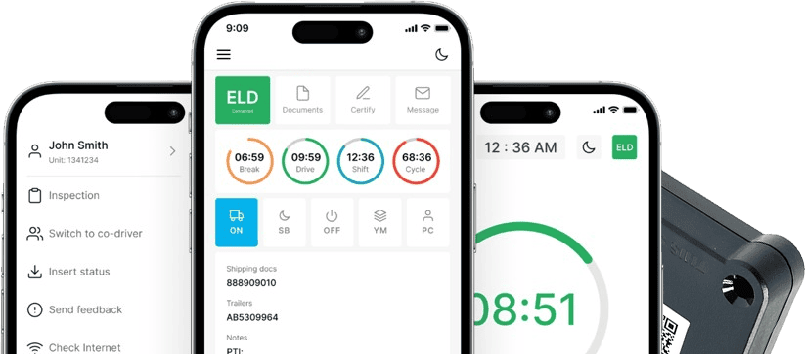
A functioning ELD does not automatically mean a driver’s records are compliant. The entries still need to reflect the driver’s actual day, get reviewed, and get properly certified. Good logging habits help reduce preventable HOS violations, especially when records are reviewed and certified consistently rather than left for later. CVSA has also made electronic logging device tampering, falsification, and manipulation its driver focus area for 2026, so unresolved ELD violations carry a little extra weight this year if they follow a driver from one inspection to the next.
Vehicle Maintenance Violations
Brakes, tires, and lighting continue to dominate vehicle out of service findings year after year, and cargo securement has become a growing concern too. The real issue is often not that something simply broke on the road. It is that the defect was already visible, already flagged during a previous inspection, or already known about and never corrected. A recurring problem tells an inspector a very different story than a one time surprise.
- Brake defects: Recurring brake issues should be corrected rather than repeatedly appearing on inspection reports.
- Tire problems: Damage, low tread, or other safety defects can escalate quickly when they go unaddressed.
- Lighting: Small lighting defects are usually easier to fix before departure than to explain after an inspector records them.
- Cargo securement: Loads that are not properly contained or immobilized are a frequent finding, and CVSA has made this the vehicle focus area for its 2026 Roadcheck.
How Violations Affect Your CSA Score
Drivers often talk about CSA points as if it works like a simple points system, but that is not quite how it functions. FMCSA’s Safety Measurement System assigns different weight to different violations depending on how severe they are and how recently they happened. A finding from last month typically carries more weight than one from a year ago, and violations tied to an out of service order can carry extra weight on top of that.
It also helps to understand that a violation, a citation, an out of service order, and a financial penalty are related but separate outcomes. Getting a violation on your record does not automatically mean a fine is coming, and not every violation leads to a truck being pulled off the road. What matters most is the pattern over time. A carrier with a few isolated findings looks very different in FMCSA’s system than one with the same violation showing up inspection after inspection.
Practical Steps to Stay Violation-Free
Real prevention comes down to small habits repeated consistently, not one big overhaul.
- Review the day’s hours of service before the truck leaves.
- Certify completed logs instead of letting them sit.
- Resolve unidentified driving time right away.
- Know the malfunction procedure for your ELD before you need it.
- Treat a repeated brake, tire, or light issue as a pattern worth fixing, not a one time fluke.
- Keep qualification documents and medical cards current.
- Correct a defect found on one inspection before the next one finds it again.
- Go back through past inspection reports to spot repeat categories.
Avoiding DOT fines starts with closing these small gaps before they turn into repeat findings. None of this requires a complicated system, just consistency.
Conclusion
Most violations do not appear out of nowhere. They start with something small that gets missed or delayed, and they only become a problem once an inspector writes them down. Paying attention to the habits behind hours of service, maintenance, and recordkeeping does more to protect your safety record than reacting after the fact. LogSafe US helps drivers and fleets keep ELD records and compliance reporting organized, making the logging side of daily compliance easier to manage.
Frequently Asked Questions
What are the most common FMCSA violations?
Hours of service, brake and tire defects, lighting problems, cargo securement, and inaccurate driver logs are the categories that show up most often during roadside inspections.
How do ELD violations affect your CSA score?
Relevant findings can feed into the Hours of Service Compliance category in FMCSA’s system, but there is no single universal point total. Severity, how recent the violation is, and whether it involved an out of service order all play a role.
What is the penalty for an HOS violation?
There is no single fixed penalty. Depending on the violation, the outcome can range from a citation to an out of service order or a civil penalty, and each case is evaluated on its own circumstances.
Can maintenance issues cause DOT violations?
Absolutely, and it happens more often than most drivers expect. A brake that has been squeaking for a week, a tire that is a little more worn than it should be, or a light that burned out and never got replaced can all turn into a written violation the moment an inspector takes a look. The truck does not need to be falling apart. Small things left unattended are usually what add up.
How can drivers avoid DOT violations?
Keeping logs accurate and certified, staying current on qualification documents, correcting known defects quickly, and securing cargo properly all reduce the chances of a repeat finding.


